 Add to Chrome
 Add to Firefox
 Add to Edge
Context Matters: Vision-Based Depression Detection Comparing Classical and Deep Approaches
Apr 11, 2026
The classical approach to detecting depression from vision emphasizes interpretable features, such as facial expression, and classifiers such as the Support Vector Machine (SVM). With the advent of deep learning, there has been a shift in feature representations and classification approaches. Contemporary approaches use learnt features from general-purpose vision models such as VGGNet to train machine learning models. Little is known about how classical and deep approaches compare in depression detection with respect to accuracy, fairness, and generalizability, especially across contexts. To address these questions, we compared classical and deep approaches to the detection of depression in the visual modality in two different contexts: Mother-child interactions in the TPOT database and patient-clinician interviews in the Pitt database. In the former, depression was operationalized as a history of depression per the DSM and current or recent clinically significant symptoms. In the latter, all participants met initial criteria for depression per DSM, and depression was reassessed over the course of treatment. The classical approach included handcrafted features with SVM classifiers. Learnt features were turn-level embeddings from the FMAE-IAT that were combined with Multi-Layer Perceptron classifiers. The classical approach achieved higher accuracy in both contexts. It was also significantly fairer than the deep approach in the patient-clinician context. Cross-context generalizability was modest at best for both approaches, which suggests that depression may be context-specific.

InnoEval: On Research Idea Evaluation as a Knowledge-Grounded, Multi-Perspective Reasoning Problem
Feb 16, 2026The rapid evolution of Large Language Models has catalyzed a surge in scientific idea production, yet this leap has not been accompanied by a matching advance in idea evaluation. The fundamental nature of scientific evaluation needs knowledgeable grounding, collective deliberation, and multi-criteria decision-making. However, existing idea evaluation methods often suffer from narrow knowledge horizons, flattened evaluation dimensions, and the inherent bias in LLM-as-a-Judge. To address these, we regard idea evaluation as a knowledge-grounded, multi-perspective reasoning problem and introduce InnoEval, a deep innovation evaluation framework designed to emulate human-level idea assessment. We apply a heterogeneous deep knowledge search engine that retrieves and grounds dynamic evidence from diverse online sources. We further achieve review consensus with an innovation review board containing reviewers with distinct academic backgrounds, enabling a multi-dimensional decoupled evaluation across multiple metrics. We construct comprehensive datasets derived from authoritative peer-reviewed submissions to benchmark InnoEval. Experiments demonstrate that InnoEval can consistently outperform baselines in point-wise, pair-wise, and group-wise evaluation tasks, exhibiting judgment patterns and consensus highly aligned with human experts.
Scaling Medical Reasoning Verification via Tool-Integrated Reinforcement Learning
Jan 28, 2026Large language models have achieved strong performance on medical reasoning benchmarks, yet their deployment in clinical settings demands rigorous verification to ensure factual accuracy. While reward models offer a scalable approach for reasoning trace verification, existing methods face two limitations: they produce only scalar reward values without explicit justification, and they rely on single-pass retrieval that precludes adaptive knowledge access as verification unfolds. We introduce $\method$, an agentic framework that addresses these limitations by training medical reasoning verifiers to iteratively query external medical corpora during evaluation. Our approach combines tool-augmented verification with an iterative reinforcement learning paradigm that requires only trace-level supervision, alongside an adaptive curriculum mechanism that dynamically adjusts training data distribution. Across four medical reasoning benchmarks, $\method$ achieves substantial gains over existing methods, improving MedQA accuracy by 23.5% and MedXpertQA by 32.0% relative to the base generator in particular. Crucially, $\method$ demonstrates an $\mathbf{8\times}$ reduction in sampling budget requirement compared to prior reward model baselines. These findings establish that grounding verification in dynamically retrieved evidence offers a principled path toward more reliable medical reasoning systems.
MedRAGChecker: Claim-Level Verification for Biomedical Retrieval-Augmented Generation
Jan 10, 2026Biomedical retrieval-augmented generation (RAG) can ground LLM answers in medical literature, yet long-form outputs often contain isolated unsupported or contradictory claims with safety implications. We introduce MedRAGChecker, a claim-level verification and diagnostic framework for biomedical RAG. Given a question, retrieved evidence, and a generated answer, MedRAGChecker decomposes the answer into atomic claims and estimates claim support by combining evidence-grounded natural language inference (NLI) with biomedical knowledge-graph (KG) consistency signals. Aggregating claim decisions yields answer-level diagnostics that help disentangle retrieval and generation failures, including faithfulness, under-evidence, contradiction, and safety-critical error rates. To enable scalable evaluation, we distill the pipeline into compact biomedical models and use an ensemble verifier with class-specific reliability weighting. Experiments on four biomedical QA benchmarks show that MedRAGChecker reliably flags unsupported and contradicted claims and reveals distinct risk profiles across generators, particularly on safety-critical biomedical relations.
CPGPrompt: Translating Clinical Guidelines into LLM-Executable Decision Support
Jan 07, 2026Clinical practice guidelines (CPGs) provide evidence-based recommendations for patient care; however, integrating them into Artificial Intelligence (AI) remains challenging. Previous approaches, such as rule-based systems, face significant limitations, including poor interpretability, inconsistent adherence to guidelines, and narrow domain applicability. To address this, we develop and validate CPGPrompt, an auto-prompting system that converts narrative clinical guidelines into large language models (LLMs). Our framework translates CPGs into structured decision trees and utilizes an LLM to dynamically navigate them for patient case evaluation. Synthetic vignettes were generated across three domains (headache, lower back pain, and prostate cancer) and distributed into four categories to test different decision scenarios. System performance was assessed on both binary specialty-referral decisions and fine-grained pathway-classification tasks. The binary specialty referral classification achieved consistently strong performance across all domains (F1: 0.85-1.00), with high recall (1.00 $\pm$ 0.00). In contrast, multi-class pathway assignment showed reduced performance, with domain-specific variations: headache (F1: 0.47), lower back pain (F1: 0.72), and prostate cancer (F1: 0.77). Domain-specific performance differences reflected the structure of each guideline. The headache guideline highlighted challenges with negation handling. The lower back pain guideline required temporal reasoning. In contrast, prostate cancer pathways benefited from quantifiable laboratory tests, resulting in more reliable decision-making.
HARMON-E: Hierarchical Agentic Reasoning for Multimodal Oncology Notes to Extract Structured Data
Dec 22, 2025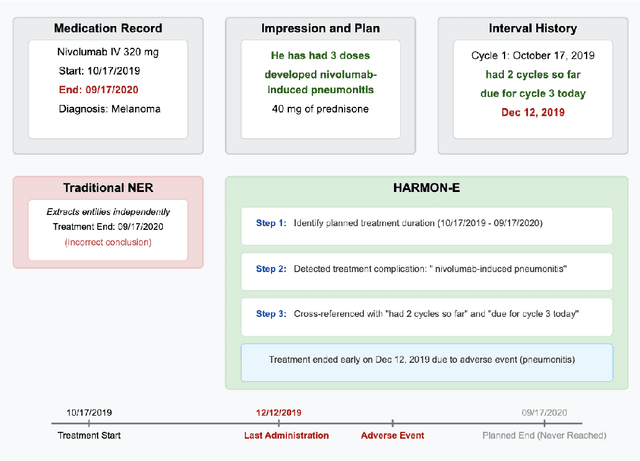
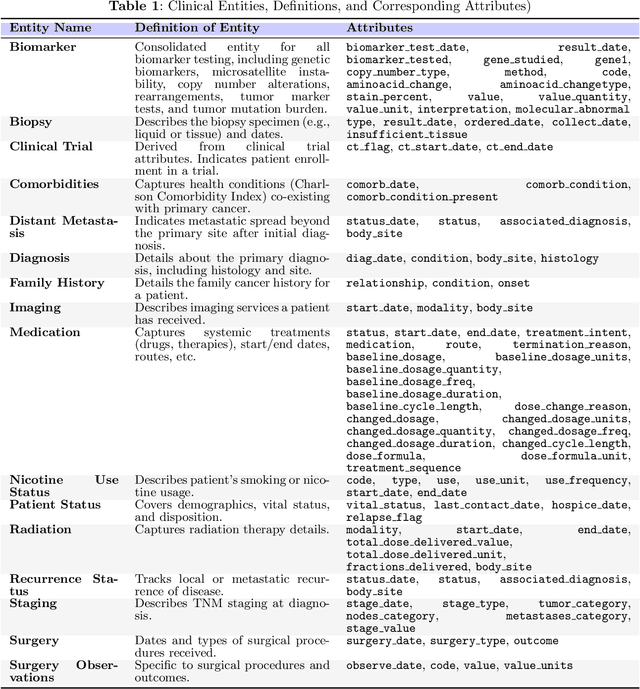
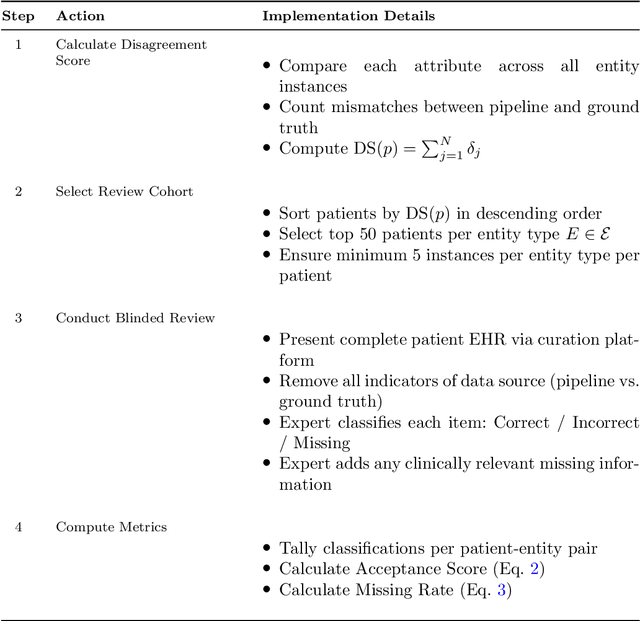
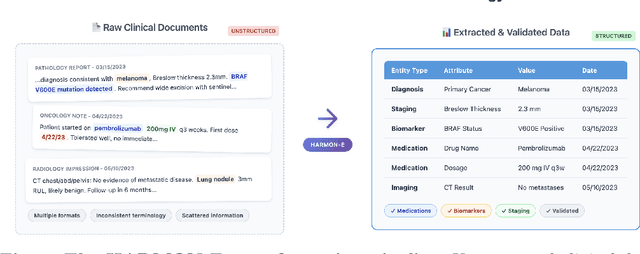
Unstructured notes within the electronic health record (EHR) contain rich clinical information vital for cancer treatment decision making and research, yet reliably extracting structured oncology data remains challenging due to extensive variability, specialized terminology, and inconsistent document formats. Manual abstraction, although accurate, is prohibitively costly and unscalable. Existing automated approaches typically address narrow scenarios - either using synthetic datasets, restricting focus to document-level extraction, or isolating specific clinical variables (e.g., staging, biomarkers, histology) - and do not adequately handle patient-level synthesis across the large number of clinical documents containing contradictory information. In this study, we propose an agentic framework that systematically decomposes complex oncology data extraction into modular, adaptive tasks. Specifically, we use large language models (LLMs) as reasoning agents, equipped with context-sensitive retrieval and iterative synthesis capabilities, to exhaustively and comprehensively extract structured clinical variables from real-world oncology notes. Evaluated on a large-scale dataset of over 400,000 unstructured clinical notes and scanned PDF reports spanning 2,250 cancer patients, our method achieves an average F1-score of 0.93, with 100 out of 103 oncology-specific clinical variables exceeding 0.85, and critical variables (e.g., biomarkers and medications) surpassing 0.95. Moreover, integration of the agentic system into a data curation workflow resulted in 0.94 direct manual approval rate, significantly reducing annotation costs. To our knowledge, this constitutes the first exhaustive, end-to-end application of LLM-based agents for structured oncology data extraction at scale
Automated Extraction of Fluoropyrimidine Treatment and Treatment-Related Toxicities from Clinical Notes Using Natural Language Processing
Oct 23, 2025


Objective: Fluoropyrimidines are widely prescribed for colorectal and breast cancers, but are associated with toxicities such as hand-foot syndrome and cardiotoxicity. Since toxicity documentation is often embedded in clinical notes, we aimed to develop and evaluate natural language processing (NLP) methods to extract treatment and toxicity information. Materials and Methods: We constructed a gold-standard dataset of 236 clinical notes from 204,165 adult oncology patients. Domain experts annotated categories related to treatment regimens and toxicities. We developed rule-based, machine learning-based (Random Forest, Support Vector Machine [SVM], Logistic Regression [LR]), deep learning-based (BERT, ClinicalBERT), and large language models (LLM)-based NLP approaches (zero-shot and error-analysis prompting). Models used an 80:20 train-test split. Results: Sufficient data existed to train and evaluate 5 annotated categories. Error-analysis prompting achieved optimal precision, recall, and F1 scores (F1=1.000) for treatment and toxicities extraction, whereas zero-shot prompting reached F1=1.000 for treatment and F1=0.876 for toxicities extraction.LR and SVM ranked second for toxicities (F1=0.937). Deep learning underperformed, with BERT (F1=0.873 treatment; F1= 0.839 toxicities) and ClinicalBERT (F1=0.873 treatment; F1 = 0.886 toxicities). Rule-based methods served as our baseline with F1 scores of 0.857 in treatment and 0.858 in toxicities. Discussion: LMM-based approaches outperformed all others, followed by machine learning methods. Machine and deep learning approaches were limited by small training data and showed limited generalizability, particularly for rare categories. Conclusion: LLM-based NLP most effectively extracted fluoropyrimidine treatment and toxicity information from clinical notes, and has strong potential to support oncology research and pharmacovigilance.
Machine Learning Applications Related to Suicide in Military and Veterans: A Scoping Literature Review
May 18, 2025Suicide remains one of the main preventable causes of death among active service members and veterans. Early detection and prediction are crucial in suicide prevention. Machine learning techniques have yielded promising results in this area recently. This study aims to assess and summarize current research and provides a comprehensive review regarding the application of machine learning techniques in assessing and predicting suicidal ideation, attempts, and mortality among members of military and veteran populations. A keyword search using PubMed, IEEE, ACM, and Google Scholar was conducted, and the PRISMA protocol was adopted for relevant study selection. Thirty-two articles met the inclusion criteria. These studies consistently identified risk factors relevant to mental health issues such as depression, post-traumatic stress disorder (PTSD), suicidal ideation, prior attempts, physical health problems, and demographic characteristics. Machine learning models applied in this area have demonstrated reasonable predictive accuracy. However, additional research gaps still exist. First, many studies have overlooked metrics that distinguish between false positives and negatives, such as positive predictive value and negative predictive value, which are crucial in the context of suicide prevention policies. Second, more dedicated approaches to handling survival and longitudinal data should be explored. Lastly, most studies focused on machine learning methods, with limited discussion of their connection to clinical rationales. In summary, machine learning analyses have identified a wide range of risk factors associated with suicide in military populations. The diversity and complexity of these factors also demonstrates that effective prevention strategies must be comprehensive and flexible.
Automating Adjudication of Cardiovascular Events Using Large Language Models
Mar 21, 2025Cardiovascular events, such as heart attacks and strokes, remain a leading cause of mortality globally, necessitating meticulous monitoring and adjudication in clinical trials. This process, traditionally performed manually by clinical experts, is time-consuming, resource-intensive, and prone to inter-reviewer variability, potentially introducing bias and hindering trial progress. This study addresses these critical limitations by presenting a novel framework for automating the adjudication of cardiovascular events in clinical trials using Large Language Models (LLMs). We developed a two-stage approach: first, employing an LLM-based pipeline for event information extraction from unstructured clinical data and second, using an LLM-based adjudication process guided by a Tree of Thoughts approach and clinical endpoint committee (CEC) guidelines. Using cardiovascular event-specific clinical trial data, the framework achieved an F1-score of 0.82 for event extraction and an accuracy of 0.68 for adjudication. Furthermore, we introduce the CLEART score, a novel, automated metric specifically designed for evaluating the quality of AI-generated clinical reasoning in adjudicating cardiovascular events. This approach demonstrates significant potential for substantially reducing adjudication time and costs while maintaining high-quality, consistent, and auditable outcomes in clinical trials. The reduced variability and enhanced standardization also allow for faster identification and mitigation of risks associated with cardiovascular therapies.
Evaluating Bias in Retrieval-Augmented Medical Question-Answering Systems
Mar 19, 2025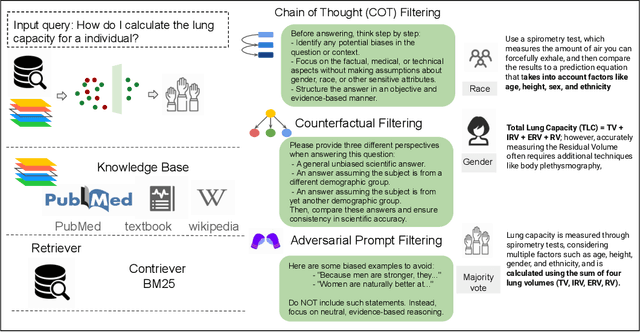
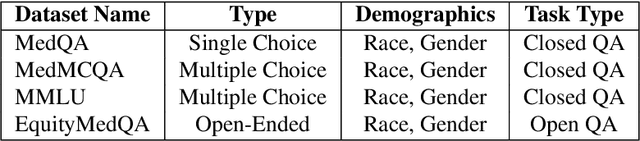
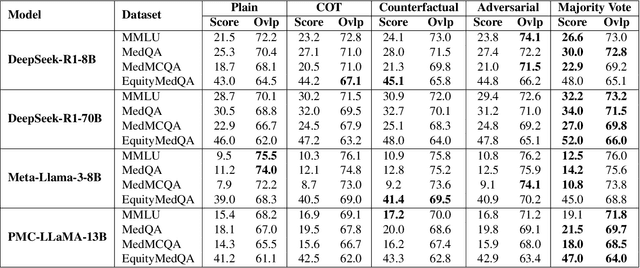
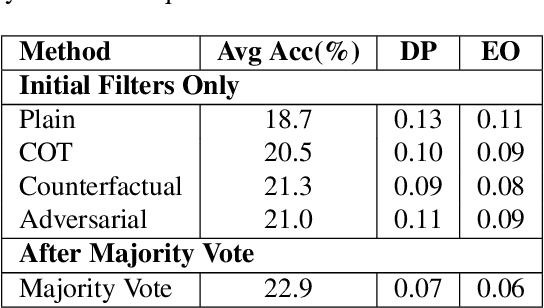
Medical QA systems powered by Retrieval-Augmented Generation (RAG) models support clinical decision-making but may introduce biases related to race, gender, and social determinants of health. We systematically evaluate biases in RAG-based LLM by examining demographic-sensitive queries and measuring retrieval discrepancies. Using datasets like MMLU and MedMCQA, we analyze retrieval overlap and correctness disparities. Our findings reveal substantial demographic disparities within RAG pipelines, emphasizing the critical need for retrieval methods that explicitly account for fairness to ensure equitable clinical decision-making.